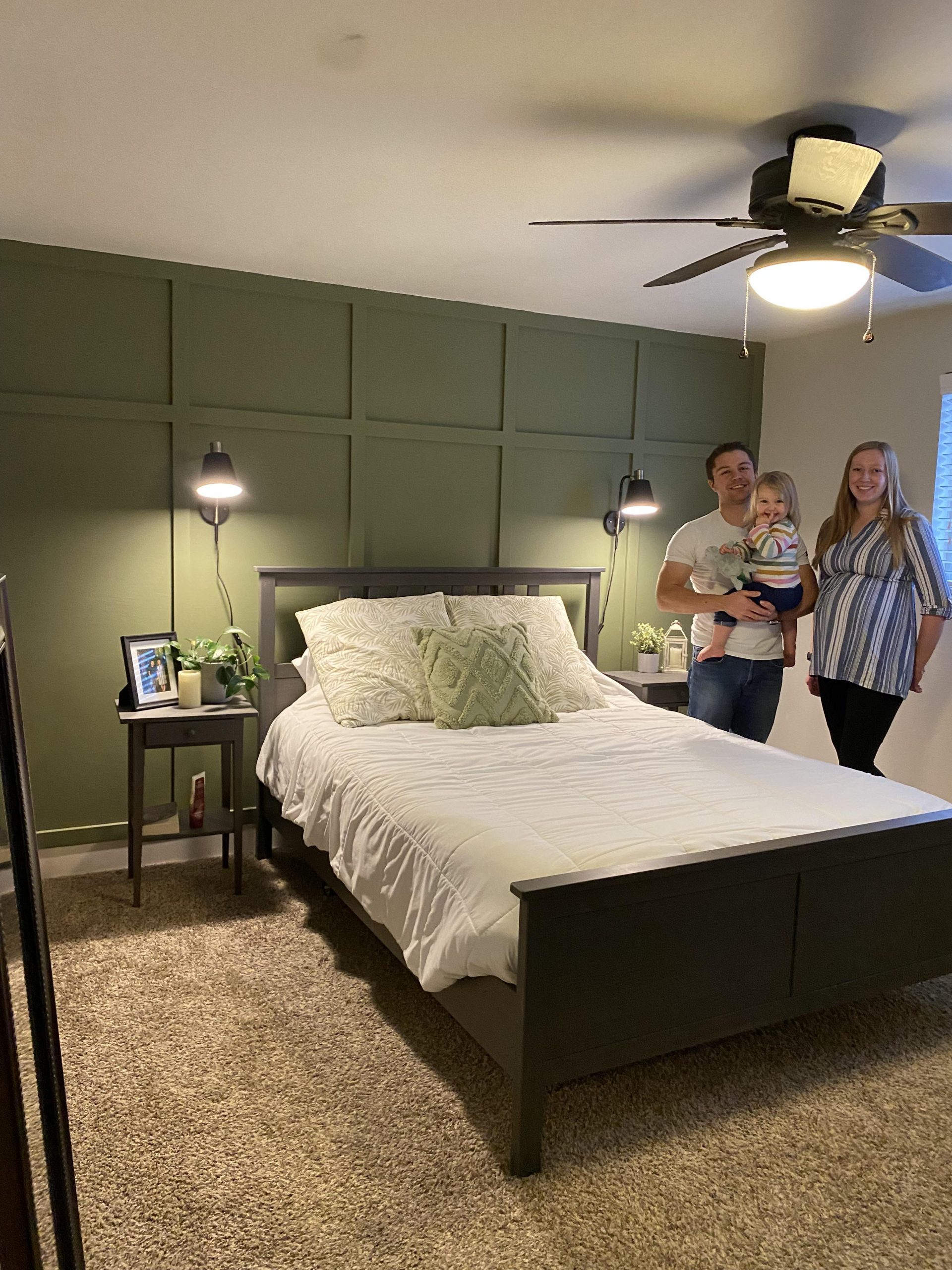
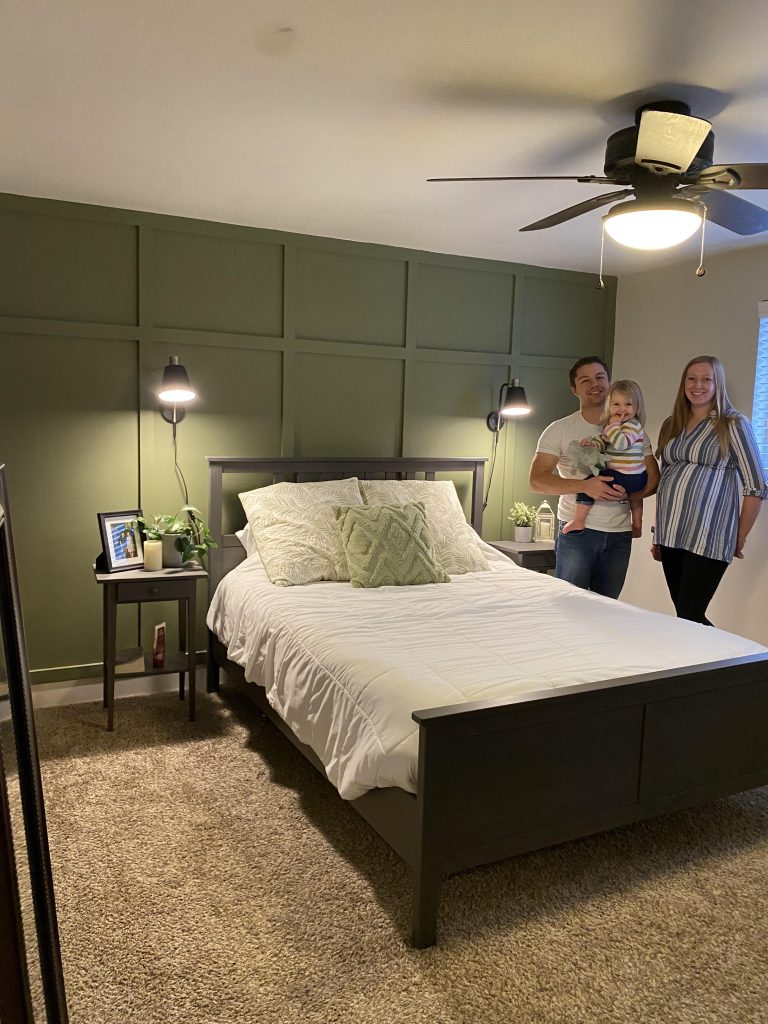
If you’re looking for a DIY home project that gives you the most bang for your buck adding an accent wall has to be at the top of the list. Whether you choose board and batten, beadboard, wallpaper, or a texture of your own design, an accent wall is a great way to add dimension to a room.
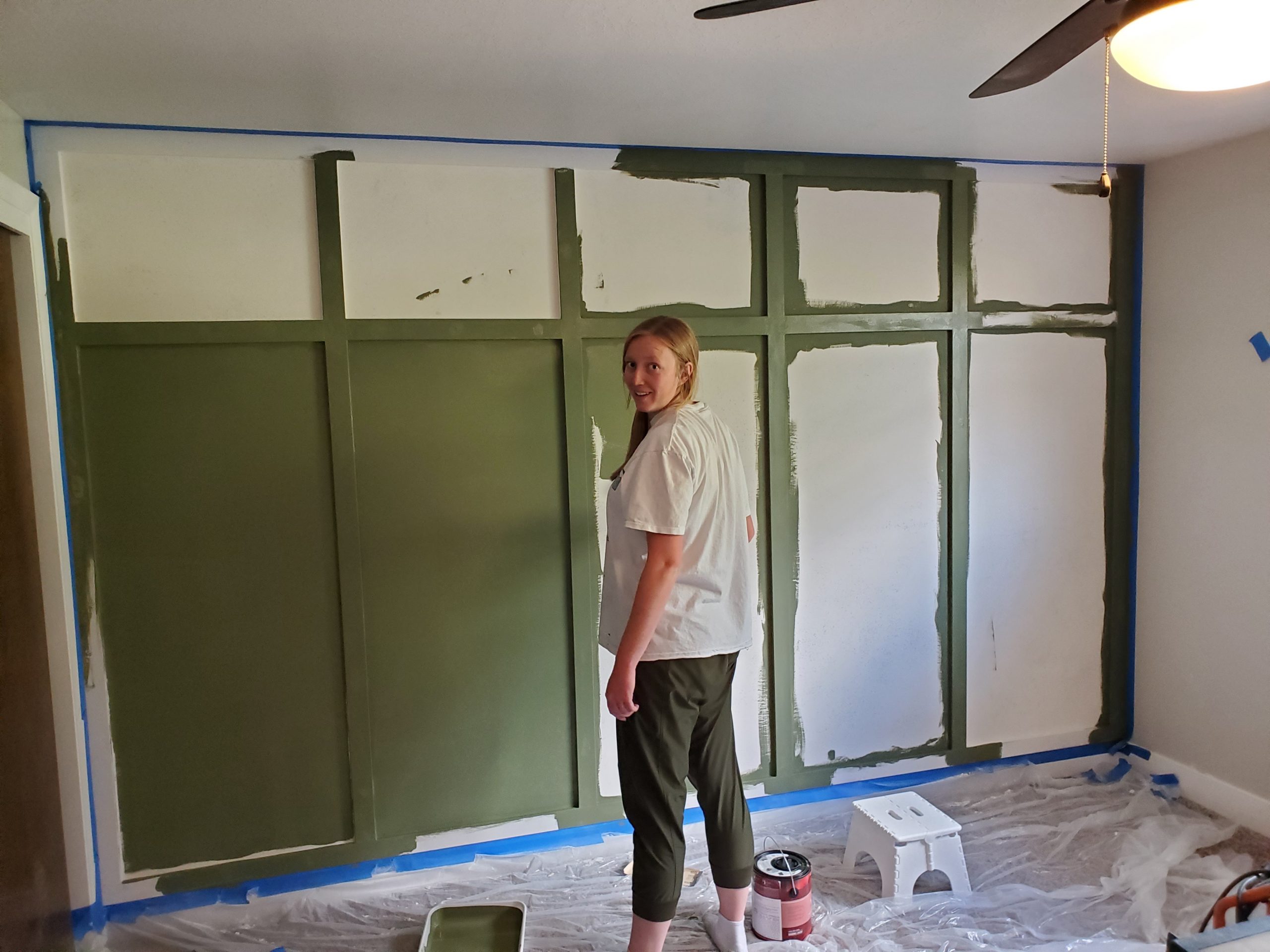
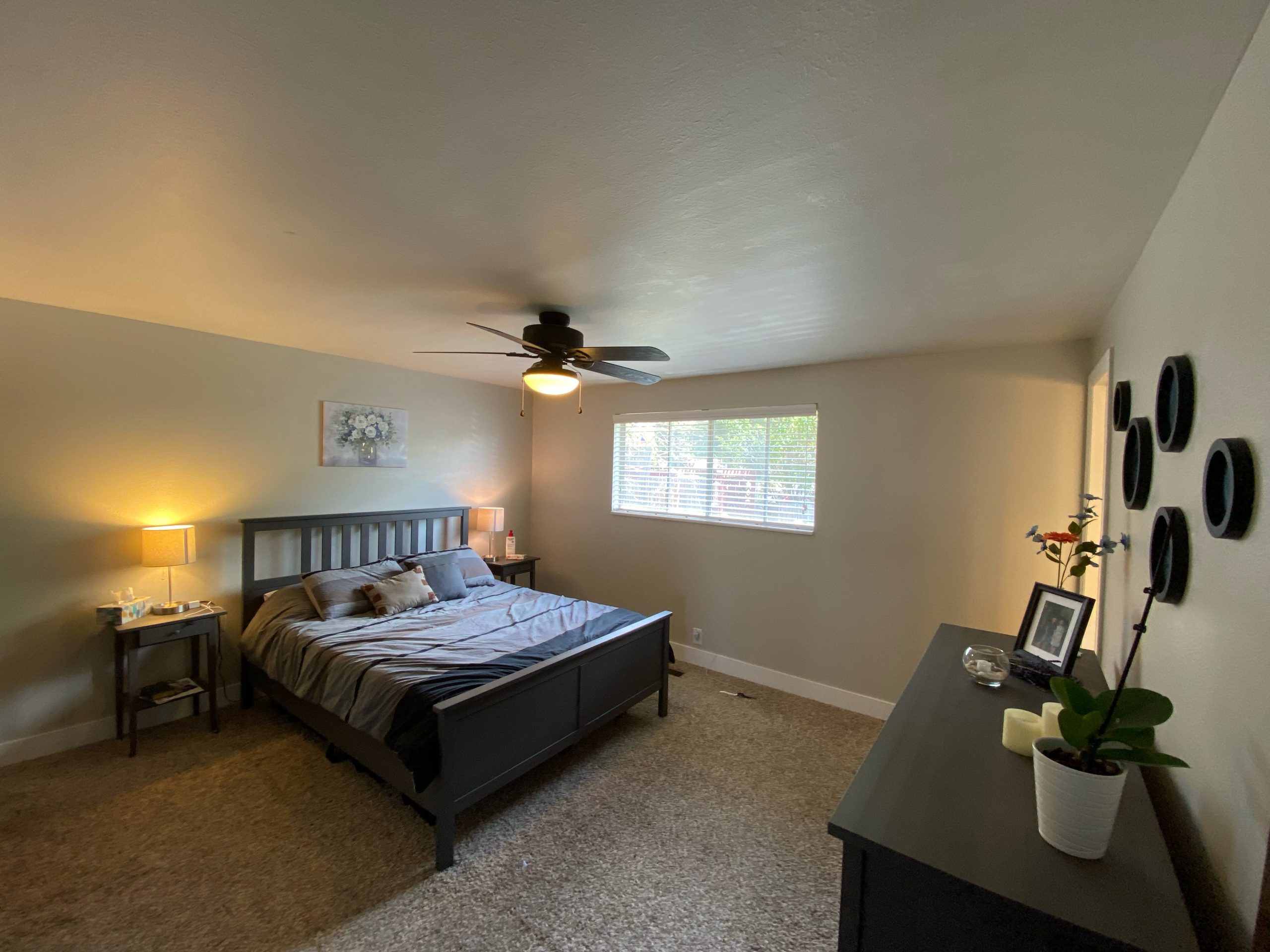
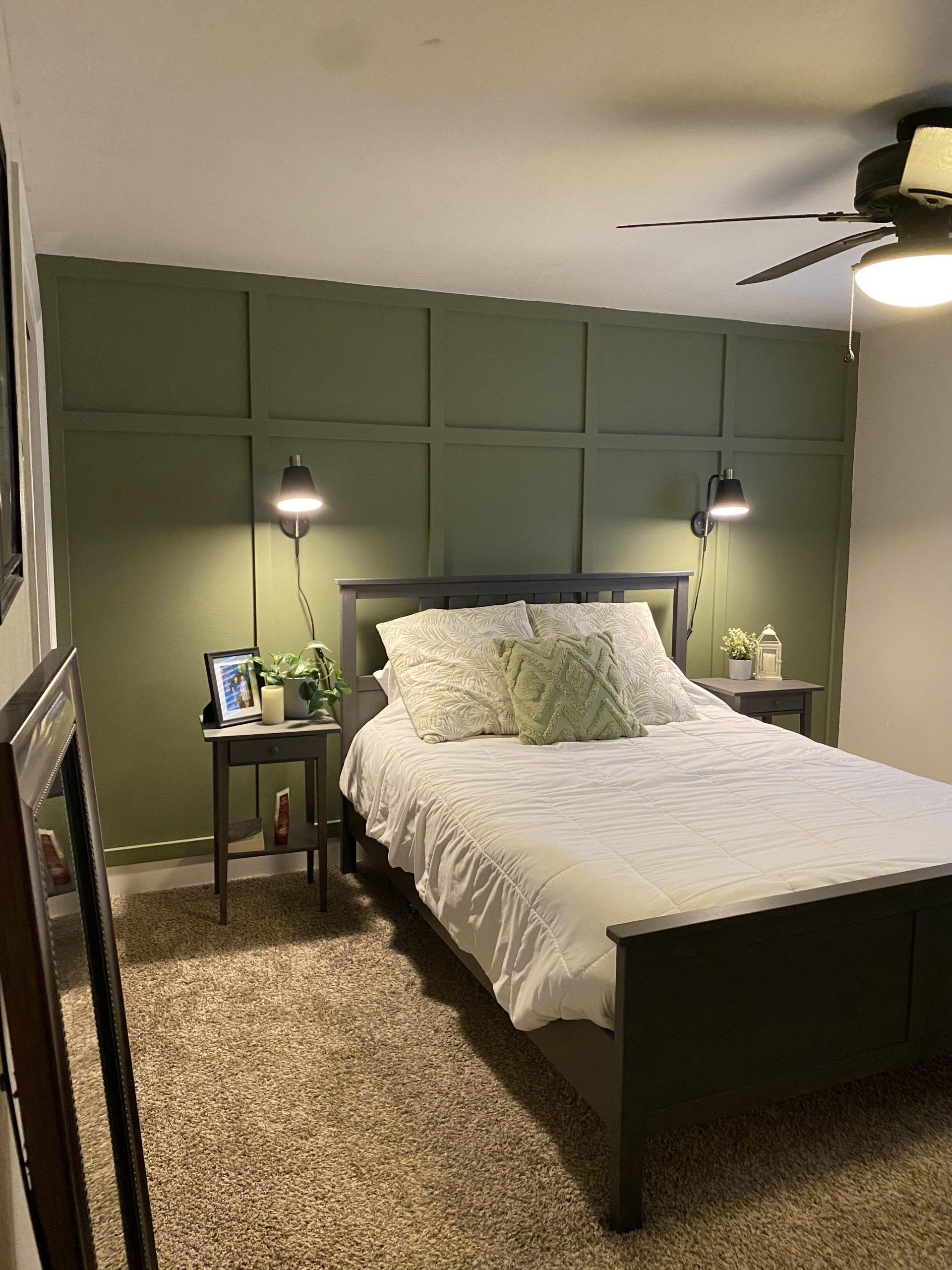
I had a wonderful interview with Daniel and Bri Burt who recently added an accent wall to their master bedroom. This budget-friendly remodel cost them less than $200 and made a huge impact. The Burt’s walked me through their process and shared some unexpected challenges along the way.
Here are 5 tips to adding an accent wall to your master room:
Pick your design – Pinterest is a helpful tool to get inspiration. Here is a board to get the juices flowing: Accent Walls
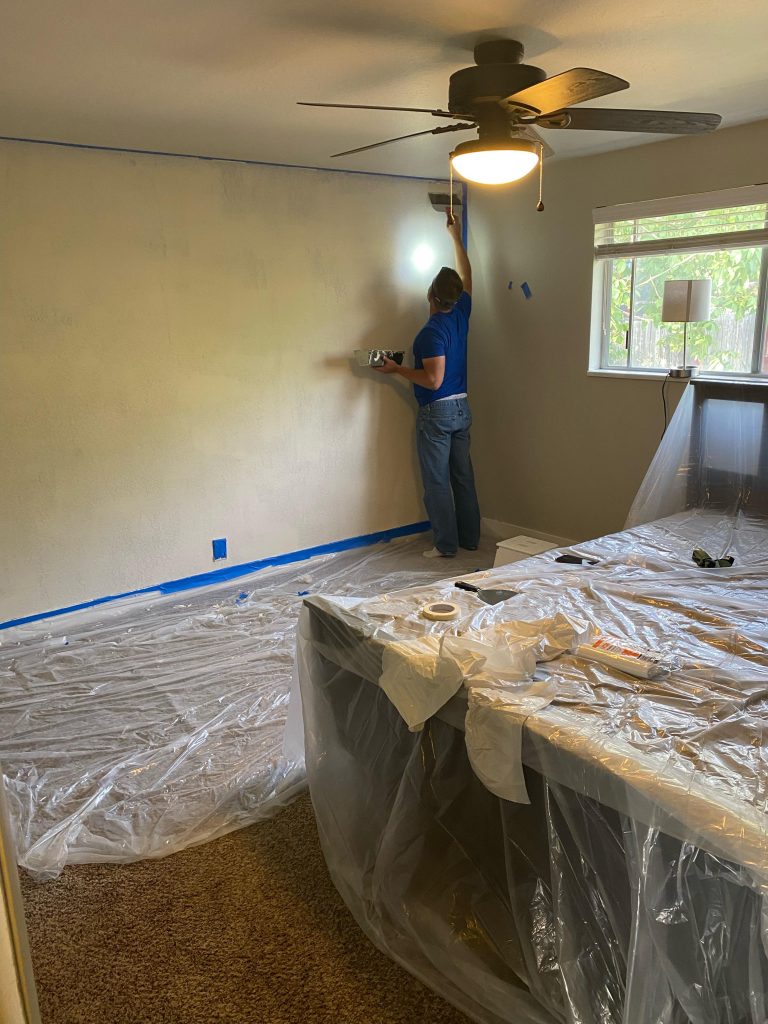
Remove texture – This important step can be tedious so give yourself time to get that smooth finish.
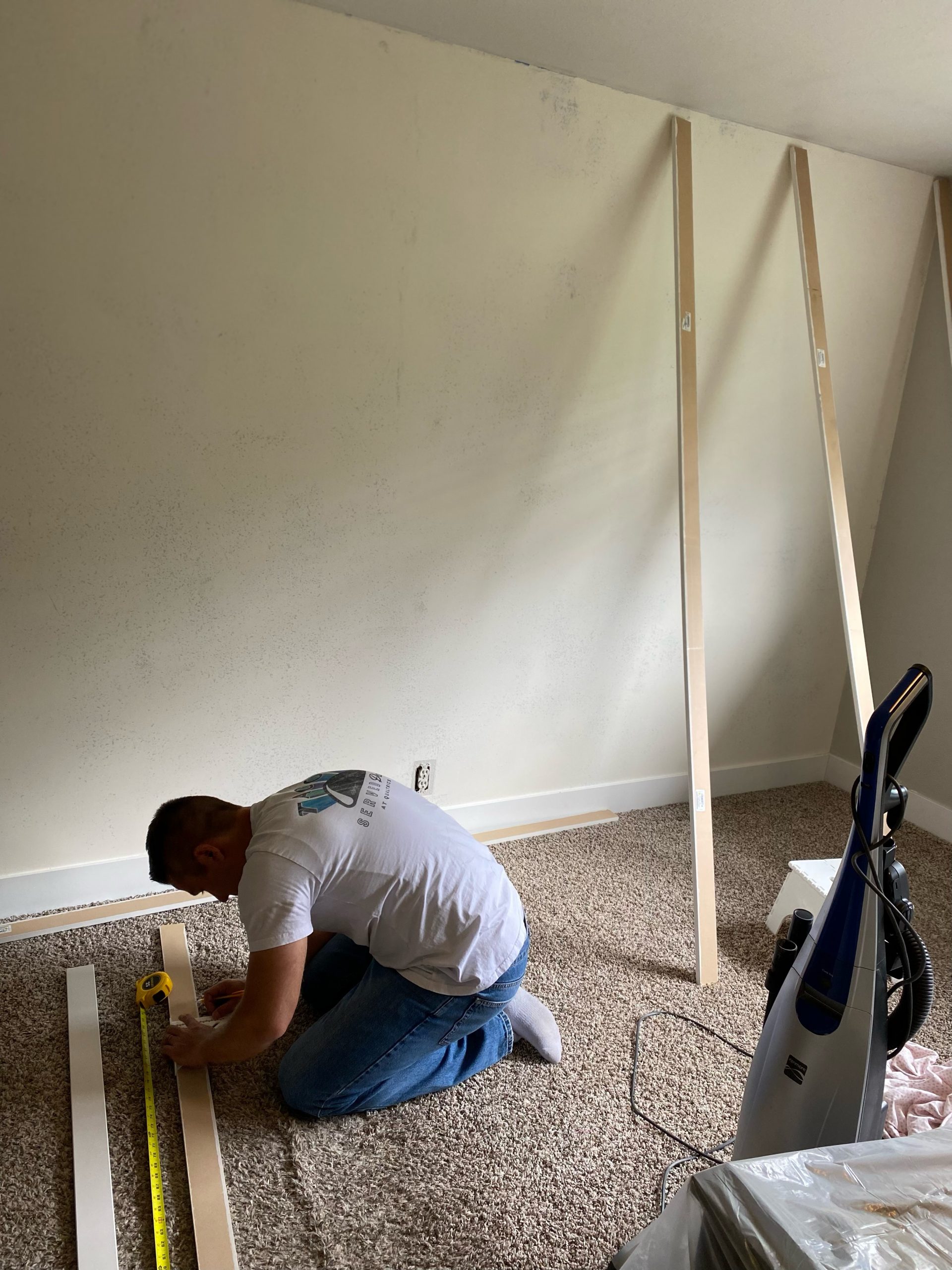
Measure A LOT – Make sure to triple check your measurements. Use a “spacer board”, or a board cut to the length you want to use as a template, to achieve even spaces.
Caulk – Using caulk around the edges gives that crisp, flushed look. You might be tempted to skip this step, but this will give your wall that professional touch.
Pick quality paint – Splurging on quality paint will save time and give you a beautiful finish. The Burt’s used Ecological by Behr in a Matte finish.
This home project is great for intermediate DIY skill levels. If you want to hire a licensed contractor to take over your home project, please send me a message and I’ll be happy to refer one of my contacts.
You can watch my interview with the Burt’s on my Youtube channel by following this link: https://youtu.be/6kAoqLrN1SU
I helped four families downsize last year. They’re now all settled in their smaller homes after selling their overwhelmingly large homes. That being said, downsizing takes a considerable amount of planning and effort.
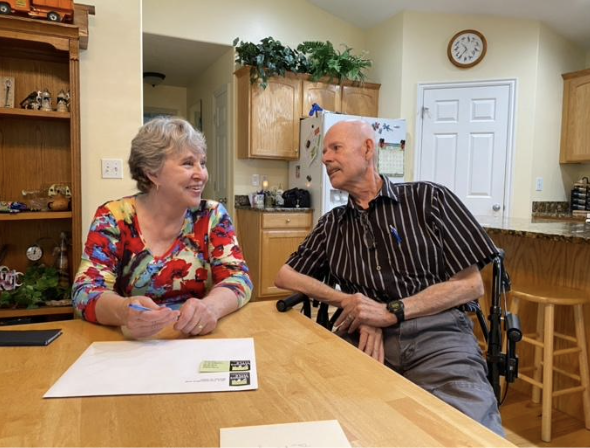
Dan and Sandy Capell were among the families that downsized last year. They sold their spacious two-story 3,676 sq foot home on a .25-acre lot, and bought a 2,536 sq foot rambler on a .11 acre lot complete with an HOA. With too many stairs and yard work piling up, their house was no longer the oasis they were hoping to grow old in.
I asked the Capells to share their experience, and they gave nine tips for those contemplating downsizing.
🏠 You can’t take everything with you
Moving from a large home to a smaller one means not all your belongings will fit. You have to analyze what is most important to you and say goodbye to the items not-so valued.
🏠 Downsizing is hard emotionally
Getting rid of their treasured items was harder than anticipated. Sandy had furniture items she loved and Dan owned many tools, guns and recreation items.
🏠 Get organized
There are lots of ways to get rid of things: give to family, sell online or at yard sales, throw items away, or donate to thrift stores and local organizations.
🏠 Find ways to give back
One thing that helped Dan be able to part with his tools was donating them to a local trade school. Knowing they will be used to help others made it easier to give them away.
🏠 Sell high priced items
Dan sold guns and other items to a local collector.
🏠 Consider hiring help
The older we get the more difficult it is to physically move. The Capells decided to hire a moving company.
🏠 Be patient
Giving away items, packing and moving is stressful. Be patient with each other and committed to getting along.
🏡 Declutter after the move
After you move, expect another round of parting with things. Dan and Sandy thought they had given away plenty, but once all the items were in their new home, they could see it wouldn’t fit.
🏠 Give yourself time to adjust
It takes time deciding where to put things, and adjusting to new patterns, friends, shopping, etc. After about two months, the Capells were beginning to feel comfortable and glad they made the move.
Dan and Sandy’s final words… “We like it here. We are glad we made the move. It was definitely the thing to do.”
Before buying or selling a home, it’s vital to have an inspection done to know the home’s condition. Most homes have at least a few things come up on their inspection.
After either inspection is completed, you’ll get a report. It is anywhere from a few to 50+ pages, depending on the home and type of inspection. We recommend going through the report in detail to see what needs to be fixed on the house before buying or selling.
Pre-Listing Home Inspection
This type of inspection is for the sellers. Golden Door Utah always pays for this inspection as part of the listing package. This type of inspection is less detailed than the Comprehensive Inspection conducted for the buyer.
The primary purpose is to check out the major systems so the seller knows the condition before listing the home. It puts the seller in the driver’s seat so they know the house’s state and what repairs the buyer may ask for.
A few examples of things found on a recent Pre-Listing Inspection were:
Clean out the window wells
Settled sidewalk – for something like this, you would wait to see if the buyer asks for it to be lifted.
Broken garage door spring (replace the springs)
Downstairs sink drains slow
Change the smoke detector batteries
Change the furnace filter
Change the light bulb in the microwave
Confirm the doorbell works
This particular home was in excellent condition; just a few (mostly) minor things needed to be fixed to make it more appealing to a buyer.
Comprehensive Buyer Inspection
When a buyer is shopping for a home, they only spend a few minutes in each home before deciding whether to put in an offer or not. There is not enough time to thoroughly assess a home’s condition.
I recommend a Comprehensive Buyer Inspection during your due diligence period. This will report the condition of the home. After the inspection, the buyer and seller may negotiate the items to be repaired. If they don’t, it may result in a buyer backing out.
If the seller does agree to fix anything after the inspection, the real estate agent will draft an addendum called Resolution of Due Diligence. Both parties will sign the agreement. Before closing on the home, the buyer will walk through to ensure the repairs have been completed as agreed. It often gives the buyer peace of mind moving into their new home.
The inspection for the buyer is much more detailed than the Pre-Listing Home Inspection. The home inspector will inspect everything from the foundation to the roof. He’ll also note the appliances and the furnace’s condition, confirm the plumbing is working properly, and that the electrical is wired correctly. The serial numbers and model numbers are also documented in the report.
Also included with the report is a sort-of manual to their house that shows things like where the water shut-off valve and electrical boxes are. Andy also provides his clients with a subscription to Homebinder. It’s an online management software that helps take care of your house. It has manuals, reminders, recalls, etc.
A Comprehensive Buyer Inspection gives the homebuyer confidence that they are buying a home in good condition.
Whether you are buying or selling a home, an inspection is a critical step. If you need help navigating the real estate process, I can help!
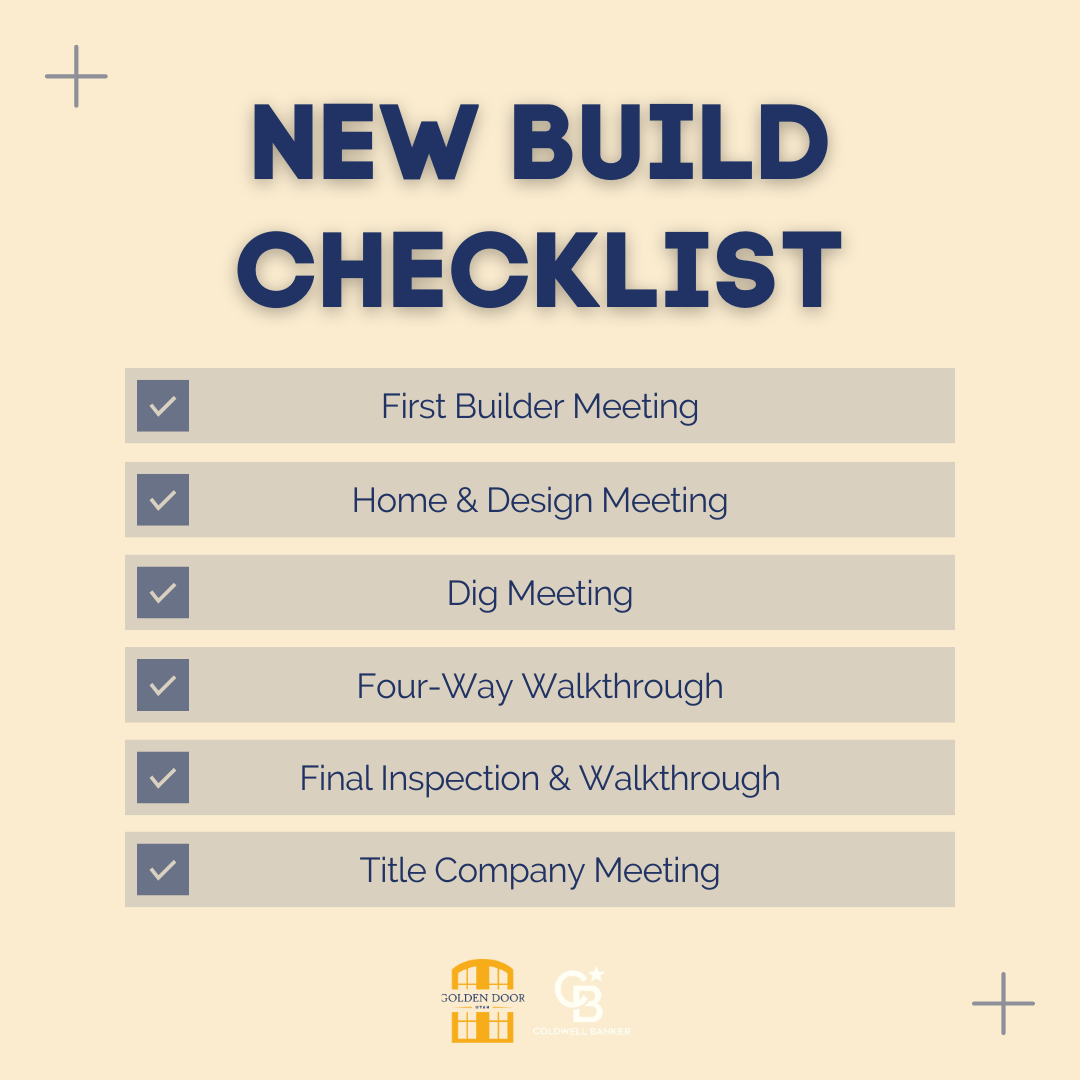
Most people don’t realize how much work and energy go into building a home. It requires numerous meetings and many decisions to ensure buyers get everything they want with their new home.
First, Doug walked us through the different floor plans, upgrade options, and pricing. We also discussed the exterior options and packages for a new construction build.
Once all of that was discussed, and the buyers decided to move forward, they signed the contracts and submitted the construction deposit. The estimated completion date for this home was about nine months.
Home & Design Meeting
The next step was heading to Woodside’s Design Center. This was a 3-hour meeting to make all home and design decisions.
Here’s what’s covered in that long but critical meeting:
Selecting everything for the home: flooring, cabinetry, countertops, hardware, faucets, etc.
Make decisions about electrical features: type of internet, placement of outlets, etc.
Interior and exterior paint colors, trim, and siding
Type of windows, furnace, water heater, and AC
Upgrade options (homes come with a standard package, but there is an option to upgrade most items)
Dig Meeting
We had a Dig Meeting with the foreman who would be overseeing the build. We walked the lot to confirm the placement of the home on the lot.We also reviewed the buyers’ selections to ensure all had been communicated correctly from the design center.
Then construction began!
Four-Way Walkthrough
Mid-way through the project is a Four-Way Walkthrough. This is where the builder and homeowner walk through the home’s framing, electrical, plumbing, heating, and AC systems. The city inspector also inspects at this time.
After this meeting, the builder is given the go-ahead to install the insulation and drywall.
Final Inspection & Walkthrough
Woodside managed the process well and actually completed the work about two months earlier than expected. It was very exciting!
During the final inspection and walkthrough, the buyers go through the home to verify that no problems need to be corrected. For any problems with the finish work, they will use blue painter’s tape to mark wherethe appropriate subcontractor needs to make repairs. If there are any scuff marks or dings, the builder will take care of them.
Sometimes other issues are found. On this particular home, one of the stucco panels on an exterior wall home differed from the others. It took the builder about a week to fix it.
The buyer returns one last time to check off the identified repairs. The building supervisor reviews what the warranty covers and how to hook up utilities, get mail keys, and other details of taking possession of the home.
Title Company Meeting
The last step of buying a new home is signing all the documents with the title company. It takes about 30 minutes and requires a lot of signatures!
Once everything is signed, the title company facilitates the transfer of funds and documentation sent to the country to record the buyer as the official owner of the home.
As you can see, it’s an extensive process to build a home. But it can be manageable and a positive experience with the right realtor and builder guiding you through the process.
Rising mortgage interest rates are on everyone’s mind lately, so I sat down with Miles Pitcher from Superior Lending to chat about why rates are on the rise and what it means for home buyers. It turns out there’s a lot more to mortgage interest rates than meets the eye!
Kathy Campbell I’m talking with Miles Pitcher about when he predicts interest rates will go down.
(At the time of the interview, rates had increased to 6.5%. On date of publication-they were around 7%.)
Mortgage interest rates recently increased to 6.5%. So those buying a home can expect to have a higher payment.
Many recommend buying now – because sellers are more negotiable on price and terms – then refinancing later when rates go down.
Miles Pitcher
Yes, that’s right.
Kathy Campbell
Why do you think interest rates will go down?
Miles Pitcher
I love talking about this.
I think it’s really important for people to understand what’s going on and what to look for.
We’ll use historical data to help improve this.
The first thing we need to remember is that inflation is the enemy of mortgage rates. As inflation goes up, so do the mortgage rates. And it has happened. That’s why we’re at 6.5% interest rate (7% on date of publication).
The Federal Reserve’s primary purpose is for price stability, which is getting inflation under control. And that is exactly what they’re doing.
This is why they raised the federal funds rate to slow down the economy, to bring inflation down. The consequence of that is that it causes a recession.
Most experts define a recession as two-quarters of negative GDP (Gross Domestic Product).
We are, in fact, hitting on our second quarter of negative GDP right now. And so we are in a recession right now.
If not, it will happen in the next quarter or so. And I think most people out there believe that a recession is coming.
Recessions are different from a housing crisis. But what we see historically, and we have 100% accuracy on this, every time in history that there’s been a recession, interest rates, from where they start the recession to where they end the recession, are always lower.
We see that as inflation starts getting under control, we enter into this recession, the economy starts slowing down, and interest rates are going to fall back down.
How far down?
We don’t know.
Do I think we’ll ever hit the twos again? Probably not.
For us to get down to low fives, back to the fours and maybe even high threes, very reasonable for it to happen and actually happen. But we believe as early as even spring next year we’ll start seeing rates come back down.
Kathy Campbell
So with 6.5% interest, when do we say, okay, it’s time to refinance?
What rate would buyers need to watch for?
Miles Pitcher
That’s a really good question.
So my rule of thumb is looking for a .5% improvement, but we take it case by case.
And here’s exactly what I look at. . .
We either try to help our clients reduce or eliminate the refinance cost. It’s a strategic refinance plan, is what we call it.
The essential question is . . . what are we going to be able to save you monthly?
We divide that by any cost of that loan to do the refinance and figure out if it takes 3 months, 6 months, whatever it is, to break even on the refinance. And as long as I can help a client have a break-even shorter than one year, we are good to go on it.
Kathy Campbell
Very helpful info. Thank you, Miles. I appreciate your time.
………
If you’re in the market for a new home or are thinking about selling your current home, please call me anytime to discuss your goals contact me.
It is almost the end of the year. In the last few months, there have been substantial increases in interest rates causing house payments to also increase.
Today we’re talking to Miles Pitcher, owner of Superior Lending. Miles, can you share some tips for helping buyers lower their mortgage payment during these times of rising rates?
Miles Pitcher
Yeah, absolutely. And in fact, it’s probably been one of the worst months for interest rates in history. And I don’t mean to be negative, but that is the reality that rates have risen significantly in September this year.
Kathy Campbell
Yes, I think it’s caught us all by surprise. I remember the first of 2022; we thought rates might get to five by the fall. I remember that prediction.
Miles Pitcher
Absolutely.
Kathy Campbell
And so now here we are. I’ve heard seven, but actually, we’re at about a 6.5% mortgage rate right now.
Miles Pitcher
That’s right. So the news is going to try to sell the news. You may hear seven mentioned, but we are about half a percent better than what they say. So our current 30-year mortgage on a conventional loan is sitting around 6.5%.
Kathy Campbell
We’ve got rising interest rates, which are increasing payments. So let’s hear the bad news – can you compare past rates to today’s rate and tell us, just how much are the rising rates affecting payments?
Miles Pitcher
Absolutely. So, what we did is we said, let’s look back before COVID, when we were experiencing a normal market.
Because COVID is kind of this anomaly, and hopefully, we’ll never see anything like it again.
I feel like we are now more in a normal market regarding inventory and being able to offer on a home and all that good stuff.
Before COVID, our rates were around 3.5%.
So if you wanted to purchase a $500,000 home and put 5% down, your total monthly payment at that price, including principal interest, taxes, insurance, and mortgage insurance would be around $2,456 a month.
You would need an annual household salary of $66,000 a year before taxes to be able to qualify for that, assuming you had no other debt.
Okay, fast forward to today where interest rates are three points higher. We are currently at 6.5%. So considering the same purchase price of $500,000 and same 5% down payment. Everything included in that monthly payment now is $3,325 a month.
So a 3% increase in interest rates translates to a house payment of $869 more per month.
Salary wise, you now have to make around $90,000 annual household salary, to qualify for that mortgage payment. And that’s assuming a 740 or higher credit score.
Kathy Campbell
Fortunately, I’ve seen sellers are a little more willing to negotiate on prices or willing to contribute to closing costs. In my last three transactions, the sellers have helped my clients with closing costs and interest rate buy down.
So how can we get that mortgage payment down?
Miles Pitcher
Let me walk through the scenario; this is exactly what I would do for my kids.
In fact, my daughter is buying a house in Houston, Texas, right now.
And these are some of the things we’re looking at. . .
Lower Mortgage Payment
2-1 Rate Buydown Method
Since the sellers are willing to give all these significant contributions, my favorite is a temporary rate buy-down.
What this is, is that you take the current interest rate and for the first year (twelve monthly payments), you make your payments based on a rate 2% below your note rate.
What that would look like in our scenario is that it would be 4.5% interest and the payment would be right around $2,760 a month.
So we just dropped your monthly payment from $3,325 down to $2,760 for all of year one. Then year two, it moves up a point.
So now we’re at 5.5% on our rate, which is around $3,050 a month, everything included.
Then year three, and for the rest of the 30 years, it’s at the full 6.5% interest rate.
But here’s the cool thing. . . .We believe interest rates will be coming back down. When we can get you locked into a lower permanent 30-year rate with no prepayment penalties, we’ll refinance you and get you locked in on that.
So that’s why this is a temporary buy down, is that it’s only for the first couple of years.
It’s a great way to help with affordability, get into the home, and capture the appreciation that will come in that home over the next couple of years while we wait for rates to come back down.
Kathy Campbell
I think that’s a tremendous strategy.
I’ve been looking online at rental costs. I looked at Northwest Orem, and I found two homes for rent. One was a two-bathroom, five-bedroom home, and the other a four-bedroom,, three-bath home. And their rents ranged from $2,575 to $2,650 a month. That is almost as much as buying a home.
Miles Pitcher
That’s right. I always remind my clients that I know the interest rate is higher right now, but if you’re renting, essentially you’re paying 100% interest. Paying 6.5% is a bargain compared to paying 100% interest.
Our big focus is when we talk to our client; we want to focus on what monthly payment you can afford and that you are comfortable with.
I’m going to stretch you a little bit. I’m going to push that and say, what’s the limit of your comfort level?
But I want to ensure that when we get you in the home, you’re not feeling unsure. I don’t want you to overextend. And so we really focus on that monthly payment.
Kathy Campbell
There are a lot of homes on the market right now with tremendous opportunities to negotiate a reasonable price for you.
Miles is a tremendous lender who can help you achieve the best possible payment. If you’re in the market for a new home, please reach out to me. I’d love to help you find the perfect property and negotiate some good terms.
Let’s talk about the thing that’s on everybody’s mind nowadays . . . interest rates.
When you are ready to buy a house, there is always the question of whether or not it makes sense for you to wait until interest rates go down. Fortunately, I’m seeing some buyers getting used to the interest rates and starting to look to purchase now. It’s incredible how the mindset of buyers has shifted.
They’re thinking, okay, I’ll marry the house, but only date the interest rate, right?
Right now, we’re seeing an increased inventory of homes on the market. Buyers have a fantastic selection out there to choose from. This is great because you can find more of a home that truly fits your needs. . . A home of your dreams that you can stay in for 5, 10, or 30 years.
If you find the home now and then negotiate good terms with the seller.
Even though you might have a bit of a higher interest rate right now, those are projected to go down in the next year or two.
So you can date that rate now and when the rates drop, refinance. Doing this can lower your payment.
I hope this was helpful.
Please reach out to me if I can help in any way. I love to answer any questions you have.
With the summer behind us, I wanted to update you on what’s happening with the market and what it means for you.
July and August were the telling months of what the rising interest rates have done to our market. To give you a little insight . . . we’re having more active listings and fewer sold properties.
Side note: These are the stats for Utah in Salt Lake County; however, if you’d like to know the specific numbers for your county, just shoot me a text, or give me a call, and we’ll send that information your way.
What are the numbers?
For the second quarter, we’ve had . . .
3,053 listings in Utah County
4, 379 listings in Salt Lake County
This is the most amount of listings we’ve had since the second quarter of 2019 for both counties.
What does this mean for you?
This tells us that we’re back to inventory levels of pre-COVID years . . . which is a great thing, right?
Absolutely!
The exciting thing is that the interest rates show an actual drop in the number of homes sold.
In the second quarter, Utah County had 976 homes sold.
You’d think . . .
Well, we’ve got over 3000 listings, right?
Yes, but less than 1000 of those properties actually sold in the second quarter of 2022.
In Salt Lake County, we had 2900 homes sold.
Even though more homes are being sold, there’s still more inventory in Salt Lake – and these numbers are pretty impressive.
There are not as many homes being sold?
Nope.
The number of homes sold in Utah County is lower than it has been since the second quarter of 2018. And before that, during the second quarter of 2017.
Salt Lake County has not seen this low number of homes sold in the last five years. And because of the interest rates, there’s been a huge drop in the number of homes sold.
It’s fascinating. . . I’ve had more buyers contacting me lately.
I honestly think people are adjusting to the interest rates and feeling like . . .
“Well, you know what? It’s a good time to get in and buy a home. And then when rates drop here in the next year or two, I’ll refinance.”
This is a little option that some of my buyers are considering and definitely something other buyers wanna think about.
What about the prices?
What’s interesting about it all is the prices.
As I look back over the last five years, the line is a constant increase. The price has not even dipped or gone since 2017.
In 2017, that very first of the year, our median price in Utah County was $294,000 for a single-family home. At the end of the second quarter, our median price in Utah County is $622,000.
Over double in the increase in values in the last five years. . . Wow, right?
Salt Lake County is very similar.
Just a touch higher, though, on the prices. In Salt Lake County in 2017, the median price was $30,6000.
During the second quarter of 2022, the median price in Salt Lake County was $637,000.
Again, this is for single-family homes. It’s not taking into account condos or townhouses.
One thing that I also think is very interesting to look at is the number of days on the market a home sits before going under contract and the percentage of the asking price the seller is getting when they put their home on the market.
We’ve definitely seen a change in August 2022.
For instance, since August 2017, most of the asking prices have been within a range in Utah County. It’s between 97% of the asking price to 106% of the asking price.
Most in those years, we’re over 100%. This means a buyer comes in and has to offer higher than what the seller is asking.
Now, this is median. We’ve had some homes that get less and some that get a lot more, but this is the median of what we’re seeing.
So, is it a buyer or seller’s market?
In August, though, of 2022, we have seen it hit 97% of the asking price.
That’s a significant change. We haven’t seen that drop that low since December 2019. We are seeing it become a bit more of a buyer’s market. When this happens, we can negotiate some concessions or the asking price just a little bit.
Similar things are happening in Salt Lake County.
In the last five years, Salt Lake County has got between 96% to 107% of the asking price. In August, we dropped to 96%. That’s the lowest we’ve seen since February 2019.
And just one more stat I want to touch on . . .
Cumulative Days on the Market
Once it’s listed, how many days does it take for a home in Utah County to go under contract?
This last quarter in Utah County took 21 days in August.
These are the days on the market we’ve seen since June 2020. We’ve historically seen single-digit days on the market in the last two years. Sometimes, only three or four days, then they are snatched up quickly.
Buyers are taking a little bit longer to decide on a home.
Salt Lake County is similar.
Last month, in August, it took 23 days on average for a home to go under contract. This is the most days we’ve seen the market.
Salt Lake County is very similar.
For August, we’re seeing an average of 23 days that a home stays on the market before going under contract. This is the lowest we’ve seen since February 2020.
Next Steps
As you can see, the market is calming down a little bit. It’s becoming a little bit more favorable for a buyer, but still, an excellent time to sell a home.
I mean, you think about it. If you can get 96% of the asking price, sell your home within three weeks.
Those are still excellent stats for a seller.
It’s just not the same craze we’ve seen during the previous Covid years, but still an excellent time.
If you have any questions or would like to know more information on your local market, please give me a call.
When selling your home, there’s a lot to think about. From staging to pricing, it’s essential to do your research to ensure you get the best possible price for your home. Staging is one of the most critical aspects of selling your home and can make a big difference in how quickly your home sells and for how much.
Here are five things to keep in mind when staging your home to sell:
First impressions matter. Potential buyers are already forming opinions when they pull up at your home. Make sure your home makes a good first impression by keeping the yard tidy and staging the front porch or entryway.
The kitchen is key. The kitchen is one of the most important rooms in the house, and staging it correctly can make a big difference. Clear off countertops, declutter cabinets, and pleasingly stage appliances and kitchenware.
The living room is where it’s at. The living room is typically the largest room in the house, so it’s important to stage it accordingly. Arrange furniture in a pleasing and inviting way, and ensure there’s plenty of light.
Highlight your home’s best features. Take a good look at your home and list out its best features. Maybe the living room’s cozy fireplace or the house’s hardwood floors. Whatever it is, make sure those features are prominently displayed when staging your home.
Less is more. When it comes to staging, it’s important to remember that less is more. You want potential buyers to see themselves in your home, so get rid of personal items and clutter. Keep furniture to a minimum and ensure rooms are well-lit and spacious.
Home staging is an essential step in preparing your home to sell. By following these few key tips, you can make sure your home makes an excellent first impression and sells quickly.
Ready to sell your home? We can help! When you list your home with Golden Door Utah, we provide staging free of charge to all our sellers.
You may have heard the rumors that we are moving into a buyer’s market. And it’s true! But that doesn’t mean there aren’t some strategies you can use to help you stand out in the market and sell your home fast.
1. Buy down the buyer’s interest rate
Reducing the price of a home by, say, $10,000 is great, but it only saves the buyer a little bit of money on their monthly mortgage payment. Instead, try giving the amount you would have reduced the price to the buyer to buy down their interest rate. It will save them upwards of $150+ on their monthly payment.
That’s a big benefit to the buyer! It allows them to step up what they can afford. If they have a tighter debt ratio, it increases the amount of money they can spend on a home. It’s a great incentive to help them with the sale of your home.
2. Offer seller financing
Another option to help sweeten the deal for buyers is to offer seller financing. This means you will finance the home purchase for the buyer. This can be an excellent option for buyers who have trouble qualifying for a loan or want to avoid paying private mortgage insurance.
You can set the terms of the loan. There are title companies who can help with the needed forms and management companies to collect and forward the payments. Your Realtor should be able to connect you with the right specialties.
3. Make your home more energy efficient
One of a buyers’ biggest concerns today is the energy bills’ cost. You can make your home more attractive to buyers by making it more energy efficient.
Some simple things you can do to make your home more energy efficient include: installing energy-efficient windows, adding insulation, and upgrading to energy-efficient appliances
Sellers, don’t give up! It’s still a great market out there with a lot of buyers. It’s a tremendous time to sell your home. By following these tips, you can make your home more attractive to buyers in a buyer’s market and sell your house fast.


 Facebook
 X
X
 Pinterest
 Copy Link